Standardizes selected numeric columns (optional), builds a distance matrix,
runs hierarchical clustering (stats::hclust), and cuts the tree into k
clusters.
Arguments
- data
A data frame.
- cols
<
tidy-select> Numeric columns to cluster on.- k
Number of clusters to extract by cutting the tree.
- dist_method
Distance method passed to
stats::dist, e.g."euclidean"(default),"maximum","manhattan","canberra","binary", or"minkowski".- method
Agglomeration method passed to
stats::hclust, e.g."ward.D2"(default),"ward.D","single","complete","average","mcquitty","median", or"centroid".- scale
Logical. If
TRUE(default), columns are standardized first.
Value
An object of class mv_hclust: a list with components cluster
(tibble with .row and cluster), heights (tibble with step,
join_1, join_2, height; join_1/join_2 use hclust merge
encoding — negative values index observation leaves, positive values
index earlier merged clusters), hclust (the raw hclust object,
useful for plot()), data_mat (the standardized analysis matrix), and
meta.
Examples
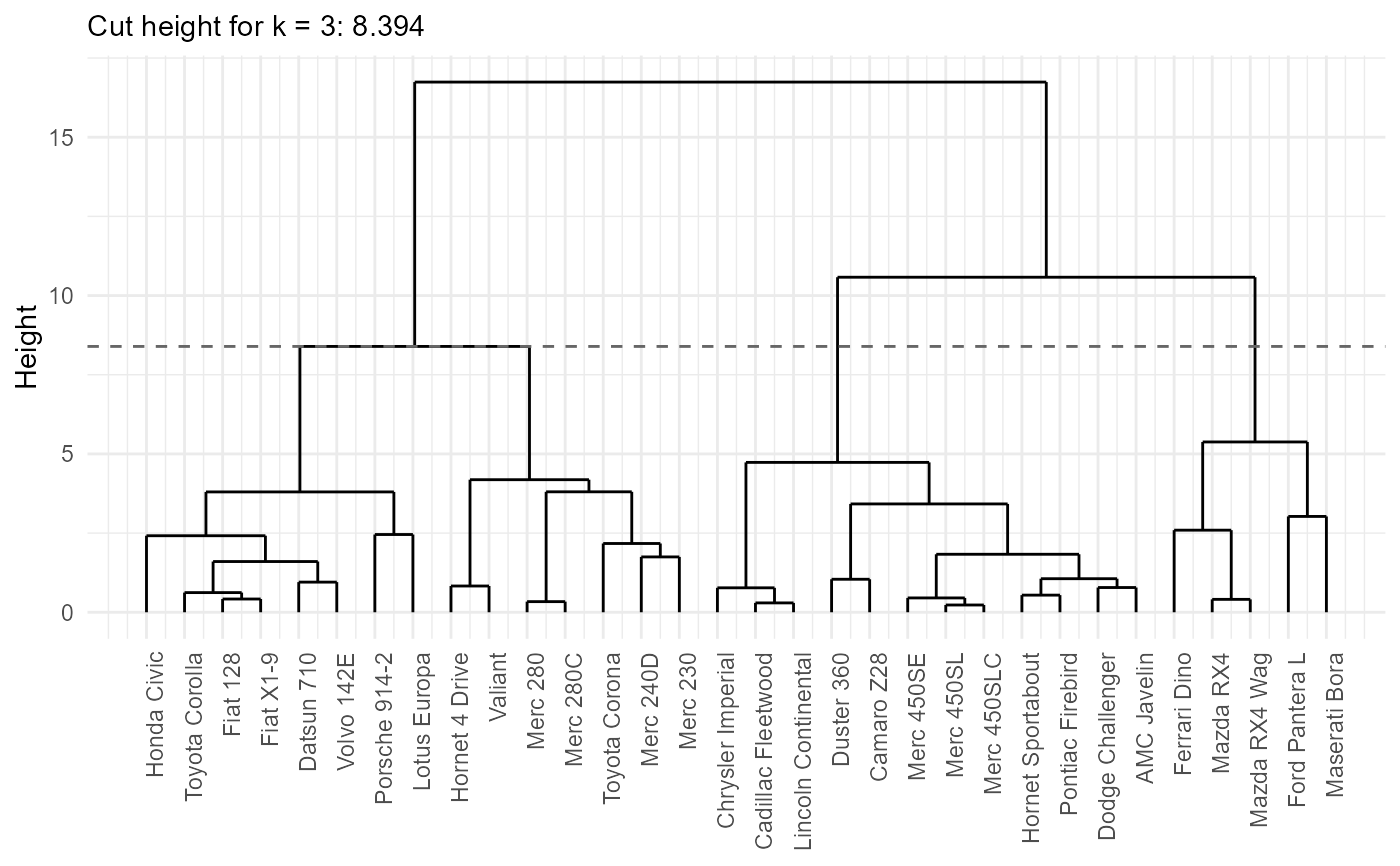
r = mv_hclust(mtcars, cyl:carb, k = 3)
table(r$cluster$cluster)
#>
#>  1  2  3
#>  5 15 12
plot_mv_dendrogram(r)